Share of renewable energy production in the world
Getting the data & Data description
The National Bureau of Economic Research (NBER) has a a very interesting dataset on the adoption of about 200 technologies in more than 150 countries since 1800. This is theCross-country Historical Adoption of Technology (CHAT) dataset.
The following is a description of the variables
| variable | class | description |
|---|---|---|
| variable | character | Variable name |
| label | character | Label for variable |
| iso3c | character | Country code |
| year | double | Year |
| group | character | Group (consumption/production) |
| category | character | Category |
| value | double | Value (related to label) |
technology <- readr::read_csv('https://raw.githubusercontent.com/rfordatascience/tidytuesday/master/data/2022/2022-07-19/technology.csv')

#get all technologies
labels <- technology %>%
  distinct(variable, label)

# Get country names using 'countrycode' package
technology <- technology %>%
  filter(iso3c != "XCD") %>%
  mutate(iso3c = recode(iso3c, "ROM" = "ROU"),
         country = countrycode(iso3c, origin = "iso3c", destination = "country.name"),
         country = case_when(
           iso3c == "ANT" ~ "Netherlands Antilles",
           iso3c == "CSK" ~ "Czechoslovakia",
           iso3c == "XKX" ~ "Kosovo",
           TRUE           ~ country))

#make smaller dataframe on energy
energy <- technology %>%
  filter(category == "Energy")

# download CO2 per capita from World Bank using {wbstats} package
# https://data.worldbank.org/indicator/EN.ATM.CO2E.PC
co2_percap <- wb_data(country = "countries_only",
                      indicator = "EN.ATM.CO2E.PC",
                      start_date = 1970,
                      end_date = 2022,
                      return_wide=FALSE) %>%
  filter(!is.na(value)) %>%
  #drop unwanted variables
  select(-c(unit, obs_status, footnote, last_updated))

# get a list of countries and their characteristics
# we just want to get the region a country is in and its income level
countries <-  wb_cachelist$countries %>%
  select(iso3c,region,income_level)
Produce the barplot gragh with the highest and lowest % contribution of renewables in energy production.
new_energy <- energy %>%
  filter(year == 2019) %>%
  group_by(country, variable) %>%
  summarise(count = sum(value)) %>%
  ungroup() %>%
  pivot_wider(names_from = "variable", values_from = "count") %>%
  mutate(renew_energy = elec_hydro + elec_solar + elec_wind + elec_renew_other)

new_energy[is.na(new_energy)] <- 0

new_energy <- new_energy %>%
  mutate(percent = renew_energy / elecprod*100) %>%
  arrange(desc(percent)) %>%
  filter(renew_energy != 0, percent != Inf)

p1 <- ggplot(new_energy %>% slice_max(order_by = percent, n = 20), aes(x = percent,
             y = fct_reorder(country, percent))) +
  geom_col() +
  labs(title = "Highest and lowest % of renewables in energy production",
       subtitle = "2019 data ",
       y = NULL,
       x = NULL,
       caption = NULL) +
  scale_x_continuous(labels=scales::percent)

p2 <- ggplot(new_energy %>% slice_min(order_by = percent, n = 20), aes(x = percent,
             y = fct_reorder(country, percent))) +
  geom_col() +
  labs(title = NULL,
       subtitle = NULL,
       y = NULL,
       x = NULL,
       caption = "Source: NBER CHAT Database") +
  scale_x_continuous(labels=scales::percent)

p1 + p2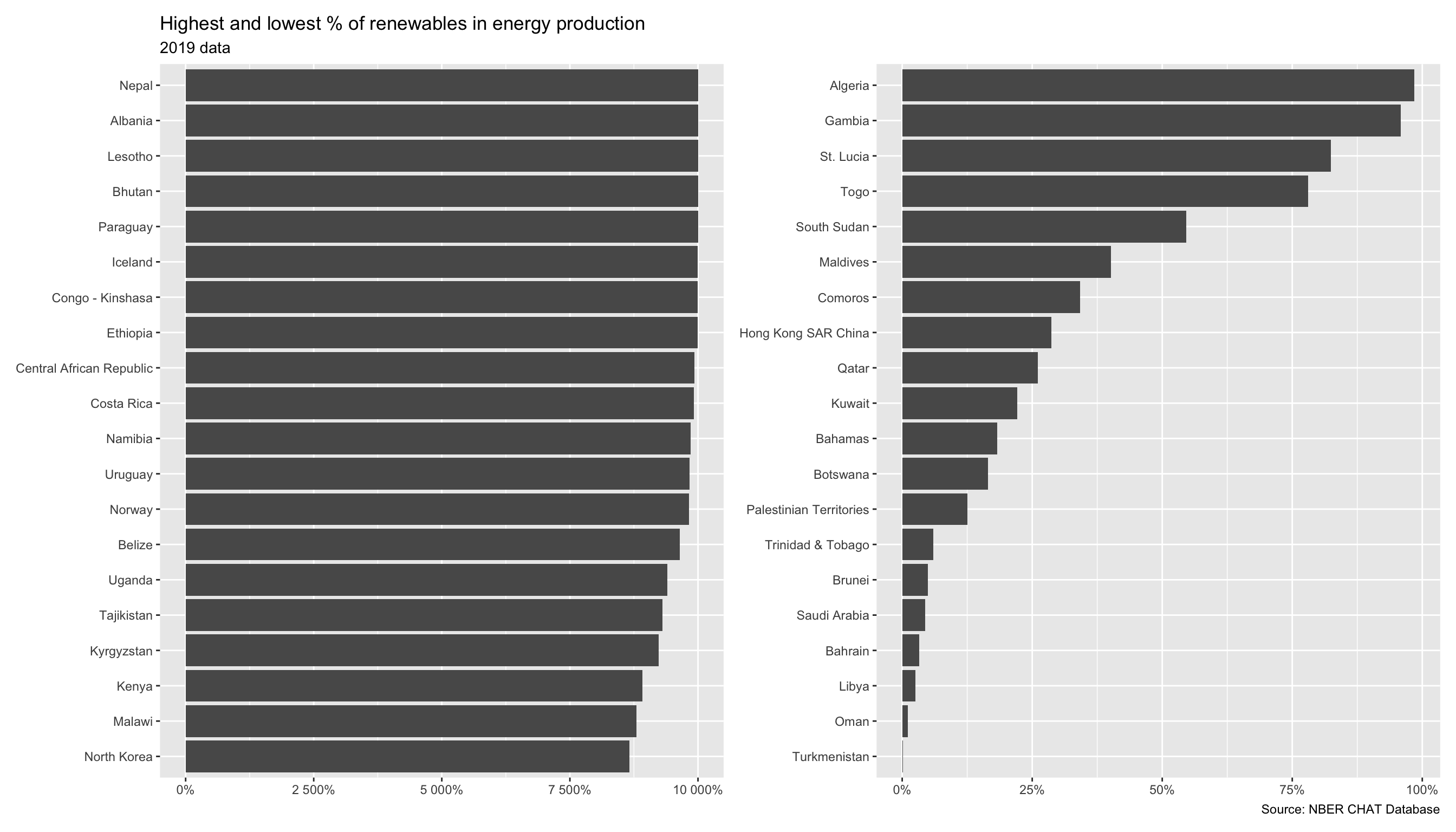
Produce an animation to explore the relationship between CO2 per capita emissions and the deployment of renewables.

new_co2_percap <- merge(co2_percap, countries, by="iso3c") # merge all the data into one dataset
new_co2_percap <- merge(new_co2_percap, new_energy, by="country" )
data <- new_co2_percap[,c(1,2,6,7,9,21)]

ggplot(data, aes(x=percent, y=value, color=income_level)) +
  geom_point() + facet_wrap(~income_level, nrow = 2)  +
  labs(title = 'Year: {round(frame_time,0)}',
       x = '% renewables',
       y = 'CO2 per cap') +
  transition_time(date) +
  ease_aes('linear') + theme(legend.position = "none")